Local Shocks, Global Ripples: Climate Disruptions in Maritime Trade Networks
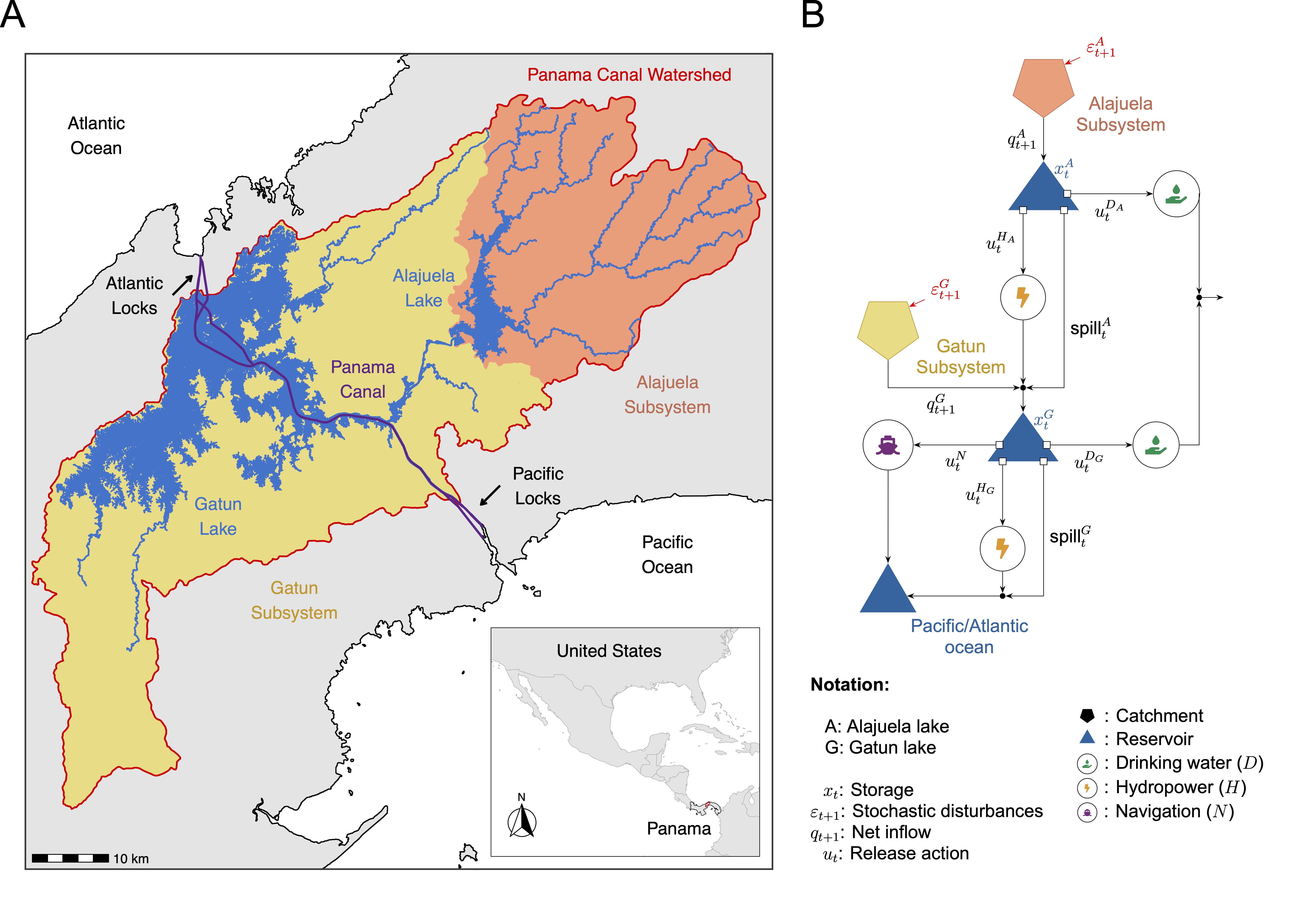
Trade can moderate climate damages by reallocating production across regions and allowing economies to import from less-affected suppliers. However, climate change can also affect the transportation infrastructure trade depends on. I study how climate-induced capacity constraints at critical transportation nodes affect trade and welfare. The Panama Canal provides a setting to trace this mechanism, as its lock system depends on rainfall-supplied freshwater, making operating capacity sensitive to lake levels. I first use observed hydrological variation to estimate effects on Canal operations and bilateral trade. I then develop a structural maritime network model with endogenous routing to quantify how the hydrological conditions change routes, market access, trade flows, and welfare. The reduced-form results reveal a nonlinear response to water scarcity: a month below the Authority’s 82-foot water-security threshold reduces Canal throughput by about 8%; during those low-water months, bilateral trade falls by approximately 1% for the average Canal-dependent pair, with larger losses where bypassing the Canal requires longer detours and gains along alternative routes. In the structural model, the transport-cost shock associated with a month below 82 feet generates an average trade decline of approximately 4% among Canal-exposed pairs as routing and market access adjust throughout the network. Welfare losses concentrate in Latin America, the Caribbean, and the United States, while some economies along alternative maritime corridors gain. The income-weighted global welfare effect is close to zero, masking substantial redistribution across economies.